

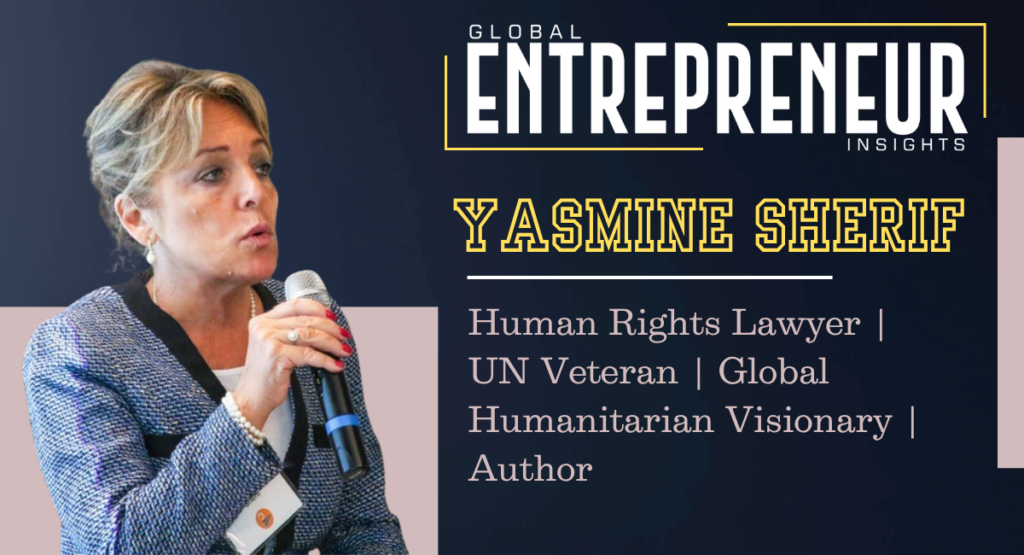
Unleashing Humanity: The Transformative Leadership of Yasmine Sherif
Human Rights Lawyer | UN Veteran | Global Humanitarian Visionary | Author | Executive Leader
In a world fractured by conflict, inequality, and widening humanitarian crises, the need for leaders who can anchor themselves in humanity and uplift others with courage and clarity has never been more urgent. Few embody this rare combination of strength and compassion as profoundly as Yasmine Sherif, an internationally respected human rights lawyer, United Nations veteran of nearly 35 years, and the visionary force behind Education Cannot Wait (ECW).
Her lifetime work has led her to the center of the most vulnerable crisis regions in the world over the decades. She has watched despair in the refugee settlements of Sudan and the battle-ridden terrain of Afghanistan, and the conflict lines of Syria and the internally displaced populations of Nigeria, she has seen the sufferings that can hobble the human spirit. But Sherif is not characterized by despair but by hope, strength, and unshaken ideas about the dignity of all children and communities that she serves.
Her tale is not just a tale of career success. It is the tale of a woman determined, with a sense of purpose, integrity, and a lifetime dedication to humanity. Sherif still carries on her mission today as an author, humanitarian leader, and the champion of justice in the world: to make every human being, and particularly children already harmed by the war and crisis, able to stand up, study, and demonstrate the maximum of their potential.
A Childhood Across Continents: The Making of a Global Citizen
Sherif’s journey begins far before her entry into international law or the United Nations. Born to a Swedish mother and Egyptian father, she was raised at the intersection of cultures, values, and identities. Her childhood was marked by global curiosity, diversity of thought, and a sense of belonging to the world rather than a single nation.
Her mother, a figure of wisdom and quiet strength, often reminded her:
“First look to serve, then everything else will follow.”
This philosophy turned out to be her guide in the worldview, her studies and her life calling.
She attended school in her early years as an international development, humanitarian law and power and justice dynamics student. Based on her training as a lawyer, she plunged into studying human rights with a specific focus on the rights of people who are pushed to the periphery of society. Since early in her life, her dreams were not placed on a comfortable life, but the life of service.
Stepping Into the United Nations: A Life of Global Service
Sherif began her UN career at a time when global politics were shifting, conflicts were escalating, and the international system was grappling with displacement at an unprecedented scale. Over the next three decades, she would serve in some of the most complex and high-risk missions across the world.
Her work took her into:
- Afghanistan, where decades of conflict had pushed entire generations into survival mode
- Sudan and South Sudan, where humanitarian catastrophe demanded urgent international coordination
- The Middle East, where children and communities endured the trauma of displacement
- The Balkans, during and after war
- Crisis-affected regions across Asia, Africa, and Latin America
In each context, Sherif demonstrated an extraordinary ability to navigate political complexity, cultural diversity, and operational risk. Her leadership style, confident, intuitive, and emotionally intelligent earned her recognition across the UN system and from global partners.
Humanity as Strategy: A Unique Leadership Philosophy
The hallmark of Sherif’s leadership is her conviction that humanity is not separate from leadership; it is leadership.
Her philosophy rests on three pillars:
- Clarity
In crisis environments, clarity is lifesaving.
“In peaceful settings, you can debate endlessly. In crisis, you must act with direction and purpose.”
- Empathy
Empathy is not soft; it is intelligence, connection, and strategy.
“You must feel the path forward before you can lead others along it.”
- Momentum
Progress requires movement. Even small steps matter.
“Never freeze. Move. Build. Adapt. That is how you transform systems.”
Colleagues often describe her as a rare blend of calm and fire, a leader who can inspire, direct, and unify teams even in moments of extreme uncertainty.
Education Cannot Wait: Building a Global Movement
Sherif’s most widely recognized leadership chapter is her tenure as Executive Director of Education Cannot Wait (ECW), the UN-hosted global fund for education in emergencies and protracted crises.
ECW was a new and ambitious concept when she took over leadership and one that the world was not so convinced of was going to be a success. But Sherif took with her the power of her clarity and strategic thinking and mobilizing power to the task. She did not put it in a global perspective: education is not an indulgence; it is life.
Under her leadership, ECW:
- Mobilized $1.7 billion in funding
- Delivered education support to 14+ million children and adolescents
- Reached crisis-affected communities in 40+ countries
- Built a global coalition spanning governments, UN agencies, donors, civil society, and local partners
Yet Sherif is quick to emphasize that the true victories are not statistics; they are human transformations.
She remembers that she was in a refugee camp in Ethiopia and she met young girls, whose lives had become the experience of trauma. But when they were in their classrooms which were paid for by ECW, their posture changed. Their eyes brightened. Their sense of self returned.
She mentions that when a girl who goes through the unspeakable picks a book and starts dreaming once again, that is humanity in motion.
It is these instances rather than international forums or strategic models that give her the drive.
Read: Dr. Shinya Yamamoto | Top Business Leader 2025 | Global Entrepreneur Insights
Working on the Frontlines: Stories That Stay with You
In northeast Nigeria, Sherif met adolescent girls who had survived captivity under Boko Haram. Many had been abused, isolated, and stripped of their identity. Initially, they were withdrawn and silent.
But when Sherif returned a year later to evaluate the impact of a reparative education program funded by ECW and the Global Survivor’s Fund, she witnessed a profound transformation.
“Their presence had changed. They stood tall. They spoke with confidence. Their inner light had returned.”
She often recounts this memory as one of the defining moments of her career—a reminder of what hope, education, and community can restore.
Beyond Gender: A Leadership Identity Rooted in Strength, Not Labels
Sherif acknowledges that gender inequality exists globally. But she refuses to let it define her identity or leadership.
“I never limited myself by gender, and I never allowed anyone else to,” she says.
“I defined myself by service, by integrity, and by performance.”
Raised by parents who encouraged strength, independence, and self-belief, she grew up knowing she could stand as tall as any leader male or female.
When confronted with insecurity or resistance, she responds not with defensiveness but with results.
“Deliver excellence. Stay centered. Stay human. Everything else fades.”
A Leader of Depth, Discipline, and Intuition
Sherif’s leadership is multidimensional rooted in:
- Legal and political expertise
- Emotional intelligence
- Intuition and foresight
- Operational discipline
- Creativity and imagination
- Cultural and global fluency
- Courage under pressure
Her ability to integrate intellect with instinct allows her to navigate complexity without losing sight of humanity.
She sees patterns where others see chaos, possibilities where others see barriers, and human potential where others see crisis.
Resilience: What It Takes to Stay Strong in a Fragmented World
Years spent in conflict environments tested Sherif’s emotional, physical, and moral resilience. Yet she insists that the heaviest challenges came not from war zones but from internal institutional politics.
“In crisis settings, people unite to save lives. In bureaucracies, egos can get in the way. That is where courage and clarity matter most.”
Her resilience is grounded in:
- Purpose
- Emotional discipline
- Empathy
- Self-reflection
- Staying anchored in humanity
- A refusal to lose sight of the mission
“I have cried for the people I served. Never for myself. Their strength fuels my own.”
A New Era of Global Leadership: What the World Needs Now
Sherif believes we are at a turning point in global leadership. The world can no longer afford leaders who manage systems; they must transform them.
Future leaders must be:
- Courageous
- Intellectually agile
- Emotionally intelligent
- Morally grounded
- Globally minded
- Innovative and intuitive
- Capable of integrating strategy with compassion
“We are entering a time that demands leadership not just of the mind but of the soul.”
Her forthcoming book, Unleash Your Humanity: Driven to Become, Inspired to Serve, expands this philosophy and offers a powerful framework for emerging leaders seeking meaning, impact, and integrity.
A Vision Beyond Institutions: Building a New Global Impact Pathway
Today, Sherif is focused on expanding her work beyond traditional institutions. Her mission is evolving into a broader humanitarian, intellectual, and social impact movement centered around empowerment, education, and emotional intelligence.
Her goals include:
- Scaling her leadership and humanitarian education programs
- Building a global initiative for youth affected by war and displacement
- Publishing her next book to inspire young leaders
- Strengthening global advocacy for human dignity and justice
Her vision is bold but profoundly human:
“To contribute. To uplift. To bridge worlds. To leave humanity stronger than I found it.”
Why Her Leadership Matters Today
At a time when global uncertainties are rising, climate emergencies, conflict, displacement, polarization, Sherif’s clarity, courage, and humanity stand as a counterforce to despair.
Her leadership demonstrates that:
- Education can be an anchor in war
- Dignity can be restored even after trauma
- Hope can be scaled across nations
- Systemic change is possible
- Humanity is a strategic asset
She reminds the world that leadership is not about authority; it is about responsibility.
Closing Reflection: A Light in a Darkening World
Yasmine Sherif is a constant leader to rely on in a century of complexity, and she moved with empathy, acted with integrity and served with purpose. It is not only about programs or policies that she works on. It concerns individuals, their lives, their future, and their dignity.
Her impact on the world is not weak; it is on time:
“Unleash your humanity. It is the greatest leadership you will ever embody.”
The world will keep seeking out such leaders as Sherif leaders who are at the crossroad of courage and compassion, intelligence and intuition, discipline and soul as the world issues keep getting tougher.
Her journey is far from over. But her legacy is already defining a new generation of intellectuals, transformers and humanitarians who are driven to create a world that any child would love to live in.


