
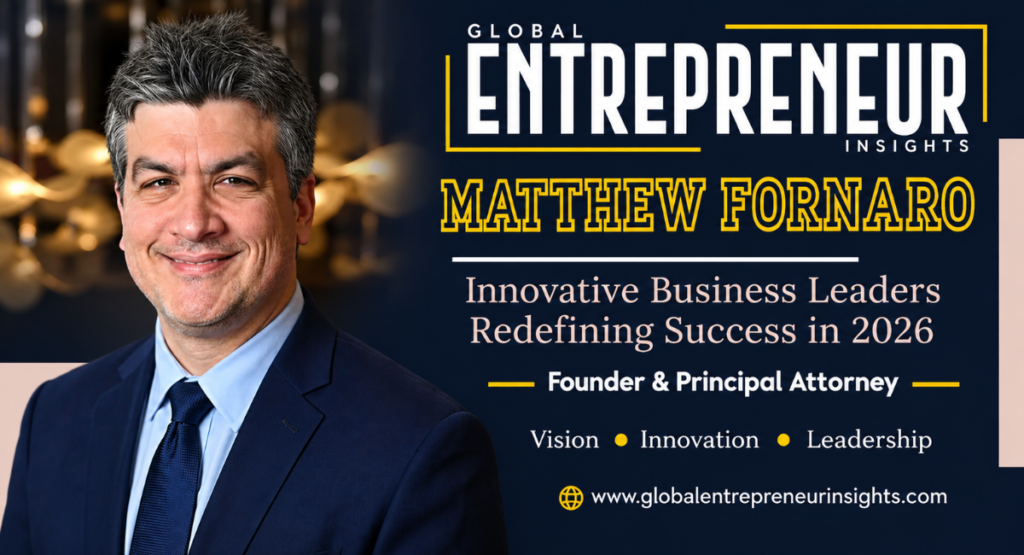
Matthew Fornaro: Practical Judgment, Legal Readiness, and the Business of Growth
Leadership Before the Crisis
In business, legal risk is often easiest to see after something has gone wrong. A contract has been breached, a partner relationship has deteriorated, a customer has stopped paying, or an important decision is suddenly being questioned. By that point, however, the business may already have fewer options than it had months earlier.
That is one reason Matthew Fornaro, Esq., founder and principal attorney of Matthew Fornaro, P.A., doing business as Fornaro Legal, has built his practice around a broader idea of business counsel. Fornaro has practiced law since 2003, but his work is not defined solely by litigation or transactions. The common thread is helping business owners understand which risks matter, which decisions deserve legal attention, and how to preserve options before a pr`oblem becomes a crisis.
Based in Coral Springs, Florida, Fornaro is a business law attorney, commercial litigator, mediator, arbitrator, and small-business owner. His career includes civil and commercial litigation, large-firm experience, transactional counseling, dispute resolution, and entrepreneurship education. That combination has shaped a practical view of leadership: preparation matters, but so do timing, judgment, communication, and the ability to adapt when the facts change.
For Global Entrepreneurs Insights Magazine’s “Low-Profile, High-Impact Leaders to Watch in the USA – 2026,” Fornaro’s story is less about visibility than accumulated usefulness. His influence is reflected in the businesses he helps structure, the disputes he helps resolve, and the decisions he helps clients make when the right answer is not obvious.
The Early Influences Behind the Practice
Fornaro’s interest in law began with an early fascination with disputes. He was drawn to the fact that people could view the same events differently and that law offered a structured way to test competing stories through facts, rules, credibility, and argument.
His interest in business was more personal. His father operated a successful small business, giving Fornaro an early view of what ownership actually demands. Customers, employees, vendors, cash flow, family responsibilities, opportunity, and risk do not arrive one at a time. Owners make decisions while several of those pressures are competing for attention.
That background would later influence the kind of legal practice Fornaro wanted to build. Smaller companies often face decisions that are existential to them, yet they may not have in-house counsel, compliance departments, or layers of management. Their legal needs can be sophisticated even when their internal resources are lean.
After graduating from the University of Florida Levin College of Law, Fornaro began practicing in 2003. His early career included civil and commercial litigation and later work at AmLaw 200 firms, including Greenspoon Marder and Shutts & Bowen. Those environments exposed him to complex disputes, institutional clients, disciplined case preparation, and the importance of understanding both the legal record and the practical stakes behind it.
Building Fornaro Legal Around a Market Gap
By 2015, Fornaro had spent more than a decade practicing law and had seen the advantages of both larger and smaller legal environments. He also saw a persistent gap. Many entrepreneurs and small and midsize businesses needed sophisticated legal analysis, but they did not necessarily need the cost structure or staffing model of a large firm. At the same time, many smaller practices did not focus deeply on the recurring legal problems of business owners.
Fornaro founded Matthew Fornaro, P.A. to bridge that divide. The goal was not to replicate Big Law on a smaller scale. It was to bring disciplined preparation and litigation experience directly to business owners while preserving the responsiveness, practicality, and direct client relationship that owner-led companies value.
Operating the firm also changed Fornaro’s perspective. He was no longer advising entrepreneurs only from the outside. He was making his own decisions about technology, workflow, client service, marketing, finances, reputation, and growth. That experience reinforced a lesson that would become central to his practice: the legally safest answer is not always the most commercially sensible answer.
A business owner must decide what to do with the information, not simply understand that a risk exists. Fornaro therefore focuses on translating legal analysis into choices: what happens if the client proceeds, what happens if the client waits, what can be controlled, what can be capped or shifted, and what decision best serves the business objective.
A Risk Budget Instead of a Risk-Free Business
One of the ideas that has increasingly shaped Fornaro’s counseling is that entrepreneurs do not need a risk-free business. No meaningful business operates without risk. The more useful goal is a risk budget.
Some risks are reversible. Others can be capped, insured against, allocated by contract, or contained by limiting who has authority to make the commitment. Other risks can survive long after the original decision and threaten the company or the owner personally. Treating every risk as equally serious produces unnecessary caution; treating every risk as acceptable produces avoidable exposure.
Fornaro’s approach is to rank risk rather than dramatize it. What is the likely downside? Can the company exit? Is the obligation personal or corporate? Can the exposure be limited? Is the risk central to the opportunity or merely incidental to it? Those questions turn legal analysis into a business decision.
This framework also helps explain why he does not identify with the “shark” or “pit bull” image often associated with litigation. Aggression can be useful when it serves a purpose, but performance is not strategy. The stronger approach is to understand leverage, timing, cost, and the client’s actual objective, then use the tool that moves the business closer to that result.
The Legal Inflection Points of Growth
Fornaro also sees growth itself as a source of legal change. A business can outgrow its original legal structure without doing anything obviously wrong. The company simply reaches a legal inflection point.
A founder who once approved every decision personally begins delegating. A customer relationship expands far beyond the scope of the original agreement. An employee is promised equity. A contractor develops valuable content or software. A second location opens. An investor asks for records. AI tools become part of internal workflows. The business has changed, but the contracts, governance documents, and authority rules may not have changed with it.
That mismatch creates a form of operational risk. The company is running one way while its legal documents describe an earlier version of the enterprise. Fornaro encourages clients to treat legal structure as operating infrastructure, something that should evolve as the business changes rather than being revisited only after a dispute begins.
This is also the logic behind periodic legal audits. The purpose is not to create a binder of documents and declare the business “compliant.” It is to turn records into decisions. A missing signature, an outdated operating agreement, and a contract practice that no longer matches operations are different problems and deserve different responses.
The Authority Gap: Who Can Actually Bind the Company?
One underappreciated growth risk is what Fornaro describes as the authority gap. In a small company, the founder may personally approve pricing, refunds, vendor arrangements, customer commitments, and exceptions to standard terms. As the company grows, decision-making spreads.
Salespeople negotiate. Managers sign proposals. Employees accept software terms. Operations teams approve changes in scope. Delegation is necessary, but it creates a basic legal and operational question: who is actually authorized to bind the company?
If that question is unclear, a business can find itself committed to obligations the owner never reviewed or discover that employees are making inconsistent promises to customers and vendors. Clear decision rights are therefore more than governance formalities. They are part of how a growing business moves quickly without losing control.
Fornaro advises companies to define material approval thresholds, identify who may sign or modify important agreements, establish limits on pricing or scope changes, and make sure internal practice matches the authority the company believes it has granted. The goal is not bureaucracy. It is clarity at the point where delegation becomes unavoidable.
The Contract Stack and the Problem of Quiet Drift
Another recurring problem is what Fornaro calls the contract stack. A relationship begins with a proposal. A formal agreement follows. Purchase orders add detail. Emails modify timing. A salesperson grants an exception. The parties later behave according to an understanding that is not reflected cleanly in any single document.
When everyone is cooperating, that drift may seem harmless. When a dispute begins, the questions become concrete: Which terms govern? Who approved the change? Was the exception temporary or permanent? Did one side rely on the change?
This is why Fornaro views contract management as an operating discipline, not a filing exercise. Businesses should know where final agreements are stored, when they renew, who owns responsibility for the relationship, and which changes require written approval. Customer and vendor relationships should be reviewed when their commercial importance changes, not only when the contract expires.
The same principle applies to informal or handshake arrangements. Trust can start a relationship, but memory is a poor substitute for documentation once money, ownership, deliverables, intellectual property, or long-term obligations become important. Formalizing the deal is not a sign of distrust; it is a way to preserve the relationship by making expectations visible.
Corporate Memory in an AI-Accelerated Business
Modern companies are creating more information and making decisions across more systems than ever. Email, text messages, collaboration platforms, cloud applications, video meetings, and AI tools all generate pieces of the business record. The challenge is not merely storing those records. It is preserving the context that explains what the company actually decided.
Fornaro sees corporate memory as an emerging leadership issue. In a young company, the founder may remember why a deal was structured a certain way, what a customer was promised, or why an employee received equity. As the company grows, that personal memory stops being a reliable operating system.
Employees leave. Managers inherit relationships they did not negotiate. Contracts are modified by email. AI can produce polished language in seconds. A company may later have the document but not the decision trail behind it.
The practical question, in Fornaro’s view, is whether the business could reconstruct a material decision if the person who made it disappeared tomorrow. Who had authority? Which agreement controlled? What was approved? Was an AI-generated recommendation reviewed? Was the change meant to create a precedent or was it a one-time accommodation?
Those questions matter not only in litigation. They appear in financing, due diligence, insurance applications, leadership transitions, audits, customer disputes, and business sales. Better corporate memory can therefore support growth as much as it supports legal defensibility.
Litigation, Mediation, and the Business Behind the Claim
Fornaro’s litigation experience continues to shape his transactional work and his view of dispute resolution. He does not assume that every dispute belongs in court, nor does he view settlement as a sign of weakness.
One confidential commercial dispute involved a client facing potential seven-figure exposure. The legal issues were significant, but so were litigation cost, operational disruption, evidence, personalities, uncertainty, and the client’s ability to move forward. The matter was prepared seriously, as though it could proceed through trial, while the strategy was continually reassessed as the case developed. It ultimately resolved through settlement.
The lesson Fornaro took from the matter is that preparation and flexibility are complementary. Preparation creates options. Judgment determines when to use them. A business win is not always the same thing as a courtroom win.
That philosophy also informs his work as a mediator and arbitrator. A dispute may be legally strong but commercially destructive. Another may require decisive litigation because a party needs compulsory discovery, injunctive relief, or enforcement against an unwilling opponent. The correct forum depends on the objective, the contract, the economics, the urgency, and the value of the relationship.
For business owners, choosing among negotiation, mediation, arbitration, and litigation is therefore a strategic decision, not merely a procedural one.
Education as a Form of Preventive Law
Fornaro’s interest in entrepreneurship extends beyond client work. He has participated in business education through SCORE, Kauffman FastTrac, and Florida State University’s Jim Moran Institute for Global Entrepreneurship.
Teaching founders has reinforced his belief that legal advice is often most valuable before the client knows to call a lawyer. Entrepreneurs naturally focus on products, customers, revenue, and growth. Ownership, authority, intellectual property, payment terms, and exit rights can feel secondary until the business becomes valuable enough for those issues to matter.
Fornaro uses education to make those decisions more visible. He emphasizes that legal planning should be proportional. Not every question requires a large legal project. The more important task is recognizing which decisions create long-term obligations or become expensive to unwind.
That principle mirrors his broader practice. Good business counsel should not create legal work for its own sake. It should help a client identify the issues that deserve attention now and the issues that can reasonably wait.
Technology, AI Governance, and Professional Judgment
Fornaro expects technology to continue changing both business operations and legal services. AI can accelerate research, drafting, document review, issue spotting, and workflow. Businesses can use the same tools for customer service, sales support, internal analysis, and automation.
But faster output does not eliminate questions of responsibility. A company still needs to know what information may be placed into an AI system, who owns the resulting work, whether vendor terms conflict with customer obligations, and who is accountable when automated tools communicate with customers or influence material decisions.
For law firms, the same principle applies. Technology can make legal work more efficient, but professional duties remain human responsibilities. Lawyers must verify the work, protect confidential information, understand the client’s objective, and stand behind the advice they provide.
Fornaro sees an opportunity for lawyers who can combine technological literacy with commercial judgment. The competitive advantage will not be using technology for its own sake. It will be using better tools to produce clearer, faster, more useful advice without sacrificing judgment, confidentiality, or accountability.
Professional Recognition Without Making Recognition the Point
Fornaro’s professional background includes more than two decades in business law, commercial litigation, transactions, and dispute resolution. He is admitted in Florida, New York, and the District of Columbia. His credentials include an AV Preeminent® Peer Review Rating through Martindale-Hubbell, recognition in The Best Lawyers in America® for Commercial Litigation since 2022, Florida Supreme Court Certified County Mediator, Florida Supreme Court Qualified Arbitrator, and FINRA Dispute Resolution Arbitrator.
He views those recognitions as meaningful because they reflect professional credibility, but not as the purpose of the work. Reputation is built through ordinary conduct repeated over time: preparation, responsiveness, candor, follow-through, and the quality of judgment exercised when the answer is uncertain.
That perspective fits the “low-profile, high-impact” theme of the Global Entrepreneurs Insights feature. Influence in professional services is often quiet. It may appear in a dispute avoided, a contract clarified, a founder who understands the downside before accepting a risk, or a business that can produce the records it needs when an investor, lender, buyer, or court asks for them.
The Personal Values Behind the Professional Work
Fornaro’s definition of success extends beyond the firm. Spending meaningful time with his family is his first priority outside work, a deliberate counterweight to a profession that can expand to fill every available hour.
His other interests include American history, particularly World War II and the 1980s, aviation, trivia, and Formula 1. He is drawn to Formula 1 because it combines preparation, engineering, teamwork, strategy, and rapid decisions under pressure. The best teams plan extensively, but they also know that the race will eventually force them to adapt.
Fornaro also identifies Dale Carnegie’s How to Win Friends and Influence People as his favorite book. Its emphasis on listening, understanding another person’s perspective, and communicating without unnecessary confrontation aligns closely with his approach to clients, negotiations, and professional relationships.
The common thread is perspective. Technical competence matters, but so does understanding people, context, and the consequences of the decision beyond the immediate moment.
Looking Ahead: Legal Readiness as a Competitive Advantage
As Fornaro looks toward 2027 and beyond, his priority is to continue growing Fornaro Legal without losing the direct, practical approach that led him to build the firm. He expects business owners to demand faster service and greater efficiency, but he also expects the value of experienced judgment to increase as companies become more technologically complex.
He is particularly interested in the legal issues that appear when companies move quickly: AI governance, digital evidence, intellectual-property ownership, founder and partner disputes, contract management, internal authority, and corporate memory. These are not isolated legal categories. They are part of what might be called legal readiness.
A legally ready company does not necessarily have a large legal department. It has current ownership records, clear decision rights, usable contracts, organized approvals, known renewal dates, company-controlled digital assets, and a process for identifying which decisions require legal review. Those systems make the business easier to finance, manage, defend, transition, and sell.
For Fornaro, that is where business law is heading. Legal structure should not sit outside the business as a collection of documents. It should function as part of the operating system that allows the company to move with greater confidence.
A Legacy Defined by Useful Judgment
When Fornaro considers the legacy he hopes to leave, he returns to a simple idea: usefulness. He wants clients to feel that they had access to counsel who understood what they were trying to build, told them the truth, protected what mattered, and helped them make better decisions.
He also wants younger lawyers and entrepreneurs to see that professionalism and entrepreneurship can coexist. A lawyer can build a business, use technology, pursue growth, and think commercially without treating integrity, competence, candor, and responsibility as negotiable.
His advice to the next generation is straightforward: believe in yourself, have a plan, and execute on it. But do not become so attached to the plan that you stop listening to new information. Protect your credibility. Put important relationships in writing. Understand who has authority. Surround yourself with people who know things you do not. And remember that trust takes much longer to build than it takes to lose.
That message captures the arc of Fornaro’s career. The law provides structure. Experience improves judgment. Business ownership adds perspective. And leadership, in the end, is measured by the quality of the decisions made when the outcome still matters.
Website: https://fornarolegal.com/
LinkedIn: https://www.linkedin.com/in/matthewfornaro
Editorial Feature – Global Entrepreneurs Insights Magazine | 2026 | Matthew Fornaro | High-Impact Legal Leader 2026